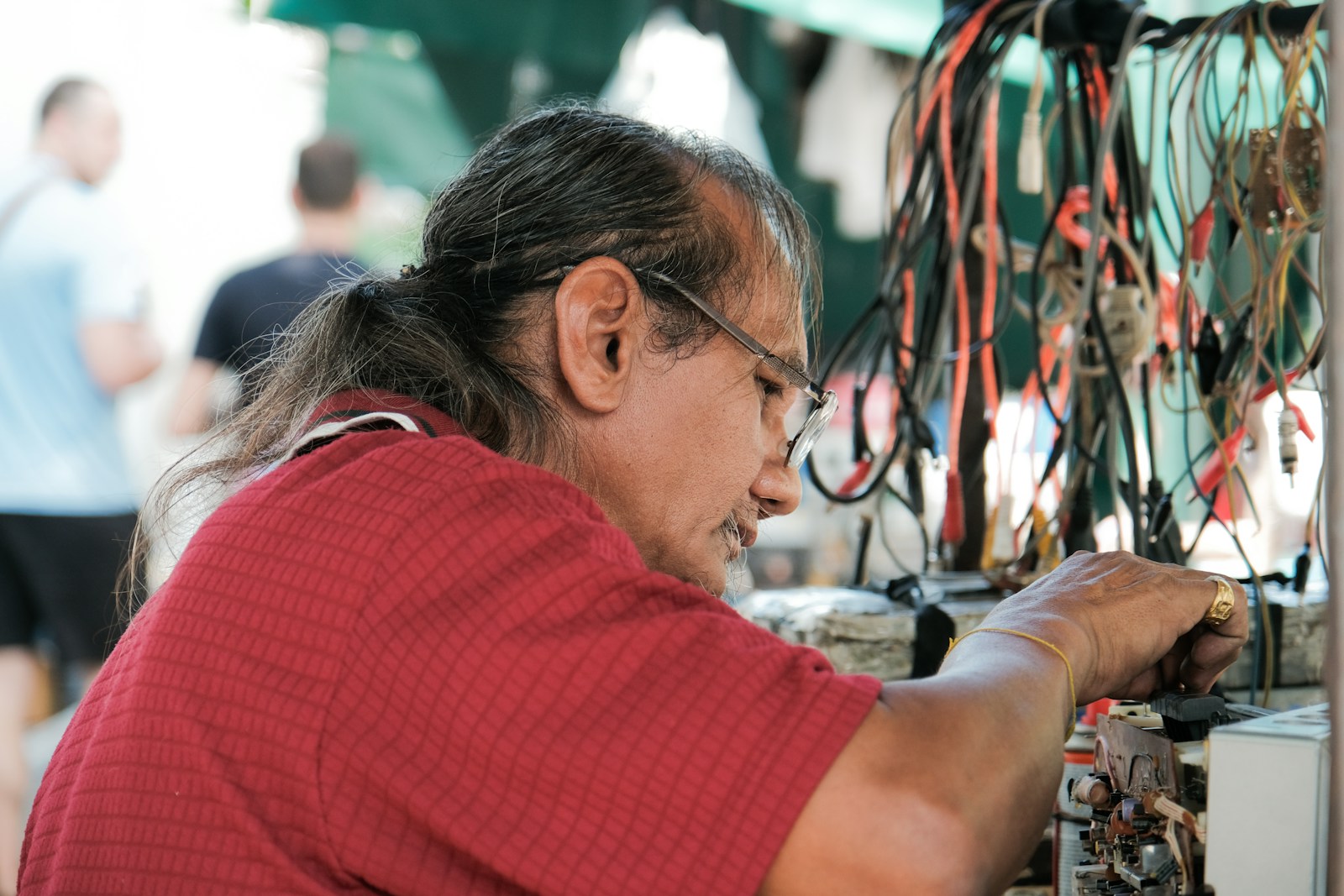
Turn over almost anything you own and you will find the truth about how long it was meant to last. Four small screws: somebody expected you to open it. A seam of glue and a sticker that says warranty void if removed: somebody hoped you never would.
We rarely read objects this way, but they are always telling us something. A radio from the seventies has a back panel held on by thumbscrews, because the people who designed it assumed that valves would fail and that someone in the house would replace them on a Sunday afternoon. A wireless speaker from last year has no visible fixings at all. Its surface is smooth, continuous and beautiful, and it is also a locked door.
A very small contract
A screw is a contract written in steel. It says that the object has an inside, that the inside can be reached, and that the person reaching it does not need a factory. It is the cheapest and most generous promise an engineer can make. It costs a fraction of a cent, adds a second or two to the assembly line, and it quietly hands the future of the object to whoever owns it.
Glue makes a different promise. It is faster on the assembly line and thinner in the product photo, and it quietly moves the decision about an object’s lifespan from the person who owns it to the person who sold it. When the battery fades, the choice is no longer yours. You can pay for a service that involves heat guns and plastic picks, or you can buy the next one.
None of this is a conspiracy. Designers glue things because the brief asks for thinner, lighter and cheaper, and because the market rewards those qualities in the first week of ownership rather than the fifth year. But the result is the same either way: we are surrounded by objects that were never meant to be understood.
The case for the ugly seam
The repair movement has spent a decade arguing about software locks and spare-part pricing, and those fights matter. But the most radical thing a designer can do costs almost nothing: leave a visible seam and put a standard screw in it.
A seam is honest. It admits that the object is made of parts, that the parts were put together by people, and that they can be taken apart again. We have learned to see seams as a flaw, a sign of cheapness, the mark of something that was not quite finished. It might be time to see them the other way round: as a signature, the mark of a maker who expected their work to be looked after.
There is a kind of beauty in that. Old bicycles have it. So do sewing machines, typewriters and the better sort of kitchen scale. You can see how they work, which means you can imagine keeping them working. That imagination is where care begins.
What the tin remembers
At the repair café in Katendrecht, volunteers keep a tin of screws sorted by size, rescued from things that could not be saved. It is the most valuable object in the room. It is also, in its way, an archive of every manufacturer that once assumed its products would be opened.
Sort through it and you find the history of an industry in miniature. Brass wood screws from furniture. Tiny machine screws from cassette decks. The odd triangular head from a toy that did not want to be opened by children, or by anyone. Each one is a small memory of a decision somebody made at a drawing board.
The volunteers talk about the tin the way cooks talk about a good stock. It is never finished; it only gets richer. When a lamp arrives missing the screw that held its shade, somebody goes to the tin, and more often than you would expect, the right one is there.
Buying for the fifth year
So here is a small habit worth building. Before you buy something, turn it over. Look for the screws. Ask whether a battery could be swapped, whether a cable could be replaced, whether the thing is held together or merely stuck. It takes ten seconds, and it tells you more about the object than any review.
You will not always choose the screwed option. Sometimes it does not exist. But the act of looking changes the question from how does this look today to how will this live with me, and that is the question that the next generation of objects will have to answer.
Glue is a promise that nobody will ever look inside again. A screw is an invitation. It would be good to live among more invitations.
Glue is a promise that nobody will ever look inside again.