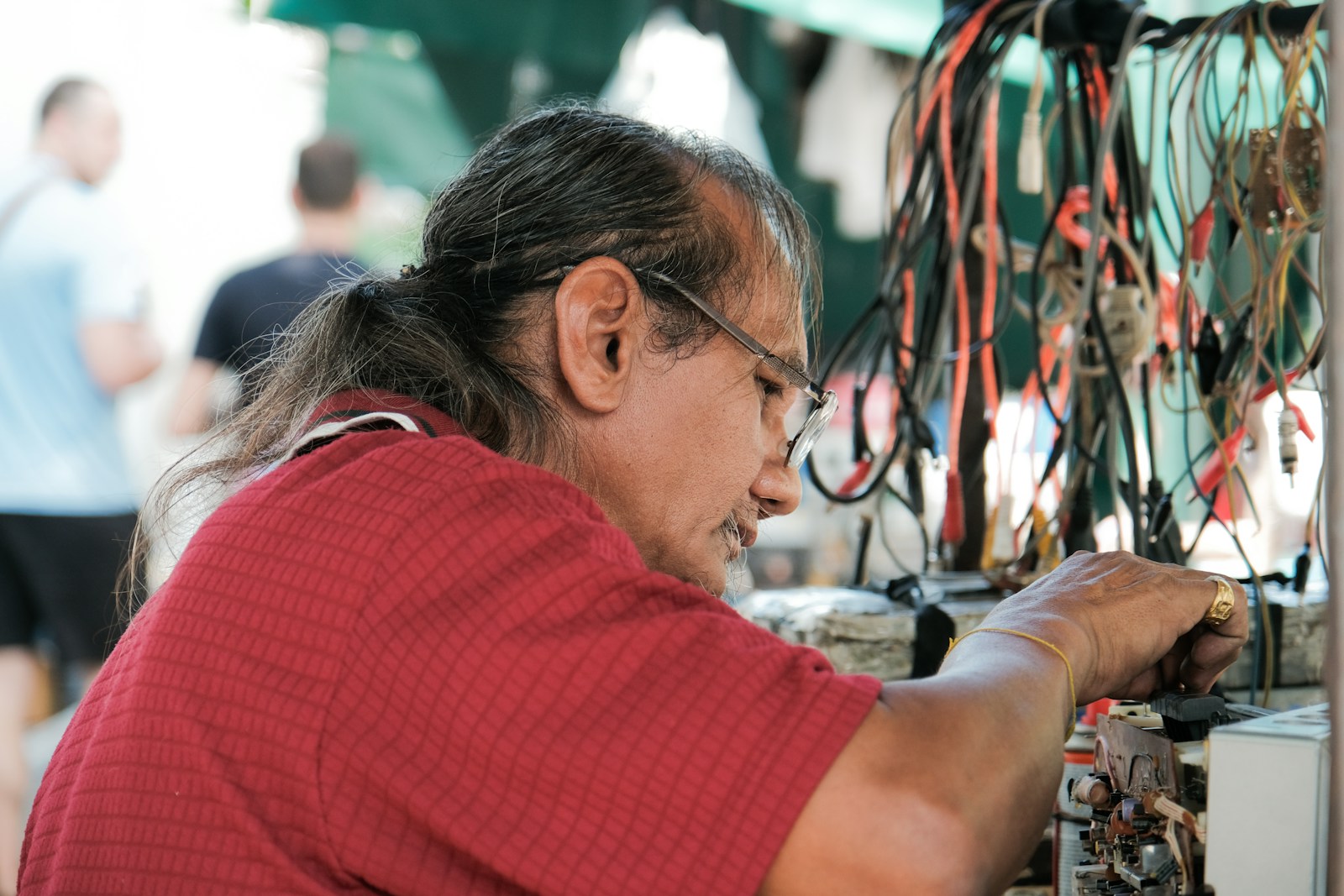
Joop Hendriks has repaired watches in the same narrow shop on Nieuwe Binnenweg since 1974. The window display has not changed much in that time: a velvet tray of second-hand pieces, a faded poster of a Swiss factory, and a handwritten card that says, simply, repairs of all kinds. We met on a quiet Tuesday morning, between customers.
The bench
Mei Tanaka: How did you start?
Joop Hendriks: My uncle had this shop. I came in to sweep the floor when I was fourteen, and he gave me a broken alarm clock to take apart so I would stop touching the customers’ watches. I took it apart. I could not put it back together. He said, good, now you know how much you do not know. That was the first lesson.
MT: And the bench itself?
JH: It was his. The wood is worn where his wrists rested, and now where mine rest. The height is exactly right for me, which tells you we were the same size. A watchmaker’s bench is high, so your eyes are close to the work without bending your back. You spend your life at that height.
Parts nobody makes
MT: What is the hardest part of the work now?
JH: Parts. Many of the companies that made these movements are gone, or they only supply their own service centres. So I keep everything. When a watch cannot be saved, I take it apart and put the pieces in these little drawers. There are spares here for maybe two thousand calibres. Some of them I have used once in thirty years. But when you need one, you need that one.
MT: And when there is no spare?
JH: Then I make it, if I can. A simple screw or a pin, yes. A balance staff, sometimes, on the lathe. It takes a day for a part that once cost a few cents to make in a factory. The customer does not always want to pay for a day. I understand. So sometimes I do it anyway, because I want to know if I still can.
Patience
MT: Is there anyone to take over the shop?
JH: No. I had an apprentice for two years in the nineties. Good hands. He went to work for a company that sells smart watches. I do not blame him. The springs are the easy part. It is the patience that is out of stock.
MT: What will happen to the drawers?
JH: I have thought about that. There is a school in the south that teaches the trade. Perhaps they will want them. Or perhaps somebody will walk in one day and ask to sweep the floor. I would give them an alarm clock.
“The springs are the easy part. It’s the patience that’s out of stock.”