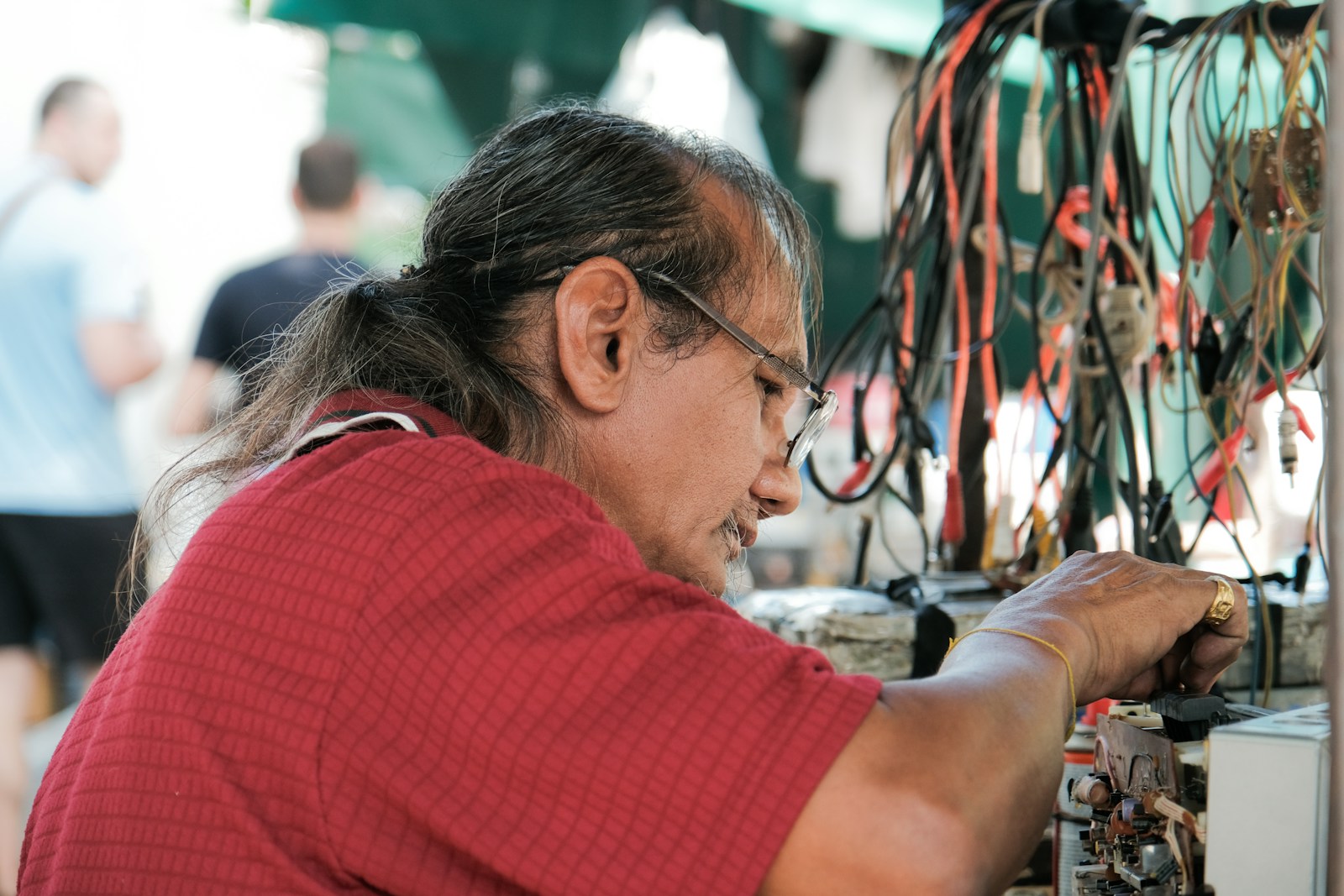
Katendrecht used to be the part of the city where sailors came ashore. Now it has cafés with good bread and a food hall in an old warehouse, but walk two streets back from the water and the older economy is still there: bike shops with bicycles hanging from the ceiling, a scrap yard behind a corrugated fence, and a man called Ferry who runs a spare-parts business out of a white van.
The van
The van has no sign. Ferry parks it on the same corner every Thursday and opens the back doors to reveal what looks like a library. Plastic drawers, labelled in marker pen, stacked floor to roof: brake pads, chain links, valves, cable ends, lamp brackets, bolts of every size. He knows where every M5 bolt in the neighbourhood lives. If he does not have a part, he knows which shop does, or which scrap bike on which balcony still has one.
Most of his customers are couriers, whose bicycles are their income. A broken derailleur on a Thursday is a lost weekend of work. Ferry fixes things on the pavement while they wait, talking the whole time about football and the price of rubber.
The yard
Behind the fence, the scrap yard sorts the city’s metal into piles: copper, aluminium, steel, and a mixed heap the owner calls the maybe pile. Ferry visits every week to walk the maybe pile, looking for bicycles and appliances that still have useful pieces. What he takes out goes back into circulation. What he leaves goes to the furnace.
It is not a romantic trade. It is dirty and cold and badly paid. But standing by the van on a grey Thursday, watching a courier ride away on a bicycle that was broken twenty minutes earlier, it is hard not to see it as a kind of quiet infrastructure: a neighbourhood keeping itself moving, one bolt at a time.
He knows where every M5 bolt in the neighbourhood lives.